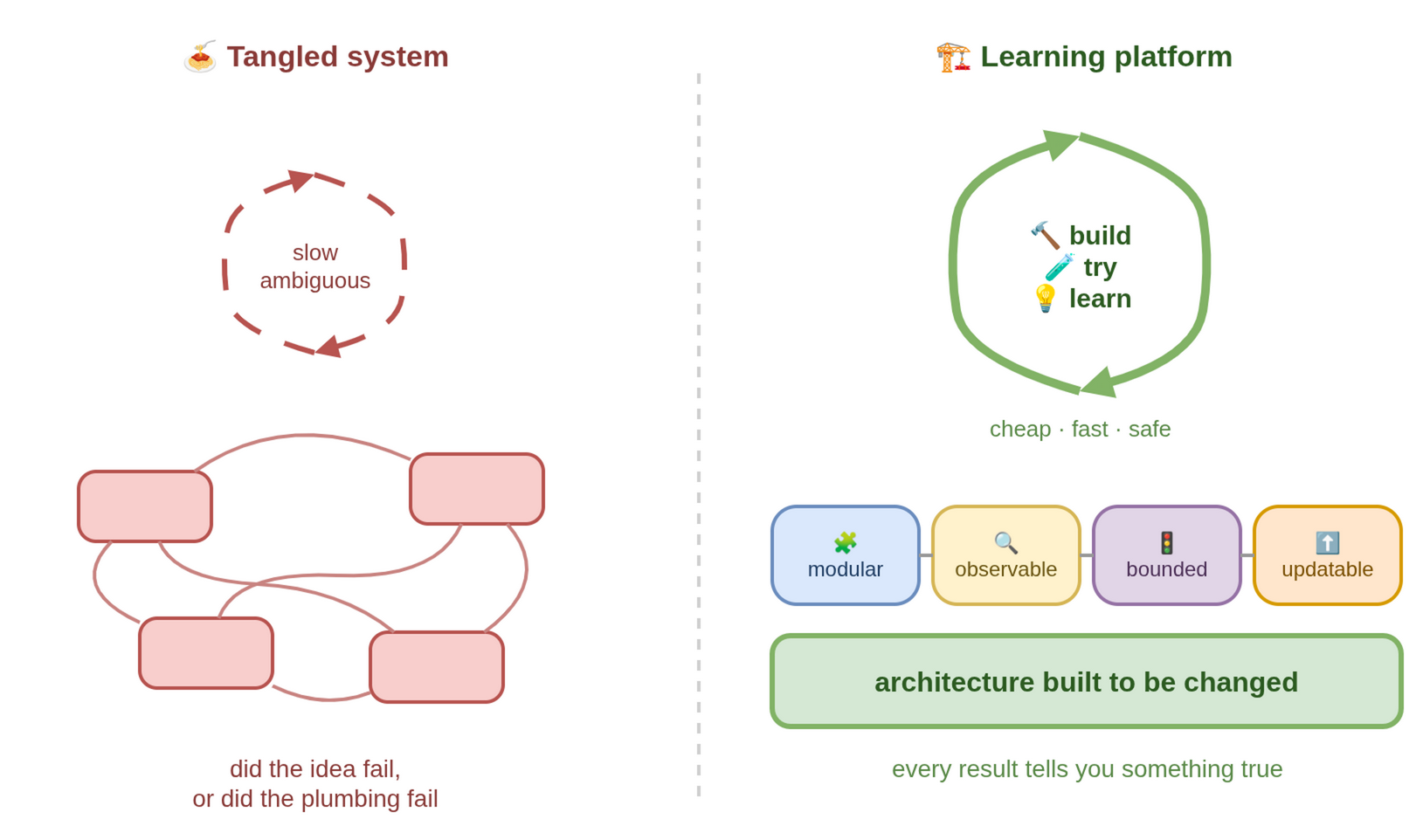
🏗️ Good architecture
We may think of “good architecture” as getting it right up front. We certainly want to do as much of that as we can, but perhaps a more important part of “good architecture” is that it enables innovation loops. Good architecture makes loops cheaper, faster, safer, and more interpretable. Some examples:
| Architecture choice | Innovation-loop effect |
|---|---|
| Modular interfaces around sensors, processing, communications, storage, and application logic | Makes it possible to replace or test one uncertain element without rebuilding the whole system |
| Automated e2e tests, logging, metrics, and fault injection | Makes failures observable rather than anecdotal |
| Feature flags and staged rollouts | Tests software hypotheses without committing every user |
| HIL (hardware-in-the-loop AI integration) | Allows agents to interact directly with hardware |
| Simple, flexible data structures | Reduces friction and risk in adding new features |
| Defined safety boundaries | Prevents “learning” from becoming unacceptable field risk |
| Update mechanism designed in from the start | Every prototype updates easily from day one |
A poor architecture does not merely make implementation slower; it contaminates the experiment. When every change affects everything else, a prototype’s result is ambiguous: did the idea fail, or did the plumbing fail?
So good architecture is not a substitute for prototyping. It is the design of the learning platform.