🧱 Organizational leverage
In a recent conversation, Yuval commented on how organizations are using AI:
more and more people will become “builders” - and that will create a proliferation of small apps/skills - where organizational leverage will become an issue. its the challenge of BYO IT but amplified 10x…
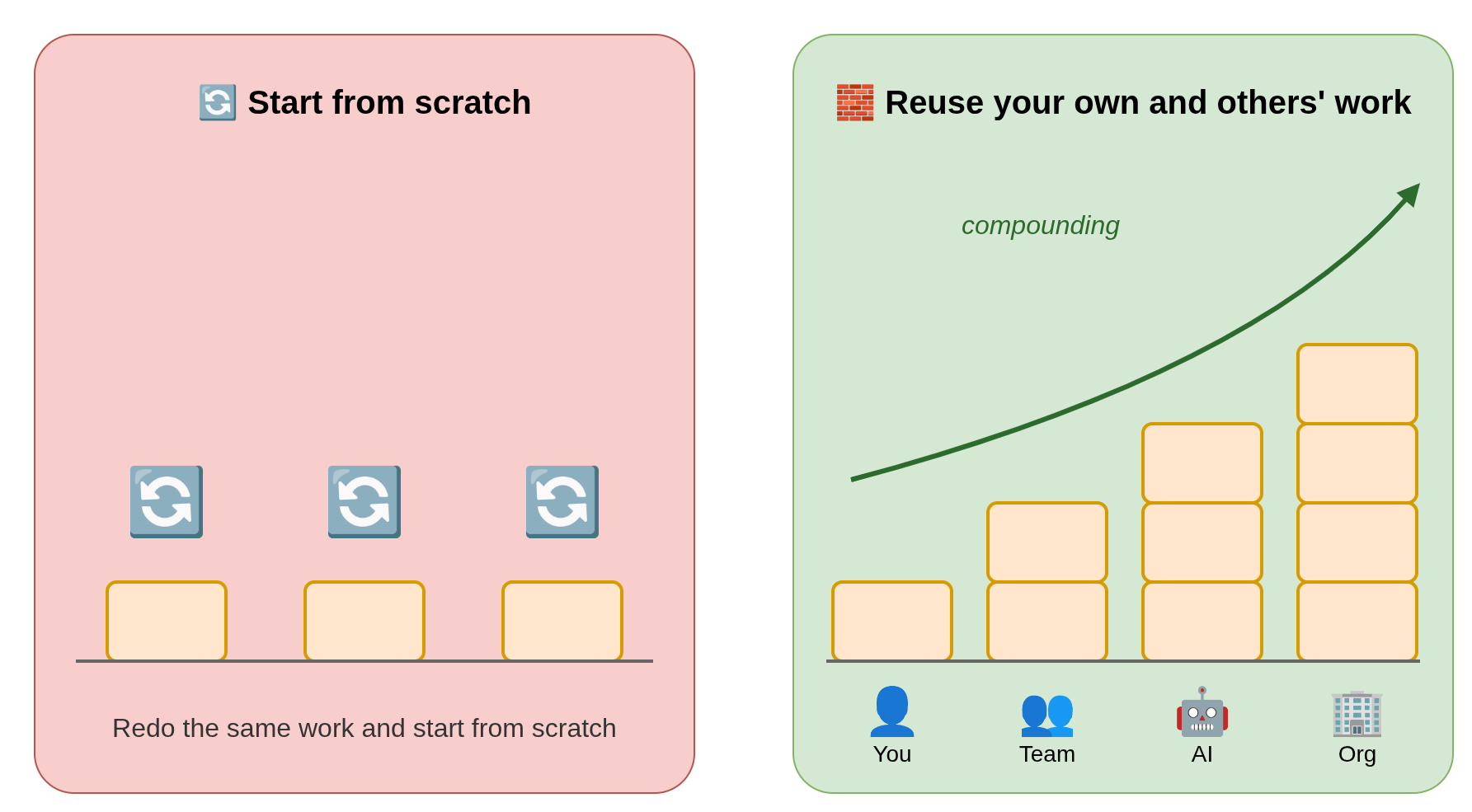
“Organizational leverage” — how do we achieve this? The simplest path I know of is to make sure as much of what we do is reusable, first by yourself and then by others, whether that is human or machine. Reuse is how compounding happens, and compounding drives growth. It is the core of the BEC Systems framework.
The deception of AI is that it is so powerful we might think “I don’t need to worry about reuse, I can just start from scratch every time — that is more fun anyway.” However, I am convinced that even in the age of AI, innovation still happens by standing on the shoulders of giants, reusing and improving work that has been done before, most importantly our own. The smallest organization is one person, so we can start with our own work. It is the stepping stone to larger organizational leverage. Whenever we catch ourselves redoing the same work, or starting completely from scratch, there is an opportunity to ask: “Has this been done before? Am I reinventing the wheel, or trying to make the wheel better?”
My OSS projects are examples of this. Simple IoT represents 8 years of observing problems, exploring various solutions and technologies, and iterating until I find what works. The [yoe] build system resulted from many years of building products with embedded Linux and a desire to solve these problems in a more elegant way. While LLMs have greatly accelerated their development, both projects are still grounded in real-world problems, leveraging what already exists (like NATS.io), and trying to solve problems in ways that have not been done before. Once the fundamentals are correct (the Simple IoT data and client model, and the [yoe] build metadata format), iterations get easier and easier.